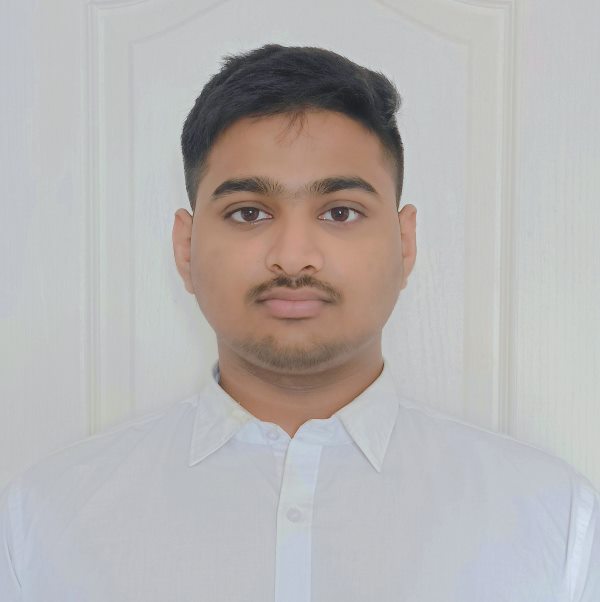
Akshay Kushawaha

Akshay Kushawaha

Software Engineer · Applied AI

Portfolio Overview

Akshay Kushawaha

Hi, I'm Akshay Kushawaha

Software Engineer I at TraceLink · Pune, India

I build intelligent software, from agentic systems to applied AI and connected healthcare. At TraceLink, I develop agentic orchestration and application infrastructure using RxJava and JavaScript.

My research spans multimodal machine learning, intelligent sensing, maternal health, and UAV perception. I’ve worked on clinical decision support using data from 1,010 pregnant women, contributed to a public multimodal dataset, and published research across healthcare, sensing, and forecasting.

I’m a Computer Science and Engineering graduate from Symbiosis Institute of Technology, Pune. I enjoy taking ideas from research and prototypes into software people can use.

8+

Hackathon & Competition Placements

5

Research Papers Published

3

Patent Applications Published

7

Work Experiences & Research Roles

Software Engineer I — TraceLink, Pune

  • Building and further developing core applications for TraceLink’s agentic AI orchestration, primarily Agentic Metadata Processing Manager (AMP) and Agentic System Manager (ASM), using RxJava and JavaScript.
  • Developed an in-house RxJava implementation of LangChain to enable agentic AI workflows and orchestration.
  • Optimized API communication in an application, reducing hundreds of API calls to just 3–4. This significantly improved application responsiveness, reduced latency, and lowered backend/API consumption costs.

Security Assurance Intern — TraceLink, Pune

  • Supported ISO 27001 and SOC 2 security assurance initiatives by assisting with audits, risk management, policy-gap analysis, and documentation across TraceLink’s Information Security Management System (ISMS).
  • Automated cross-platform security reporting by centralizing data into a unified system, eliminating manual reporting effort and improving update frequency from biweekly to near real time.

Research Associate — Symbiosis Institute of Technology, Pune

Project: Next-Gen Maternal Healthcare: AI-Enhanced Risk Assessment, Clinical Decision Support, and Continuous Maternal Monitoring

  • Worked toward rapid pregnancy-risk screening in resource-constrained healthcare settings, translating clinical requirements into the application, database, and AI pipeline.
  • Developed a Flutter-based application and machine-learning models using clinical data from 1,010 pregnant women provided by the university hospital. The resulting research was published in Birth (Wiley).
  • Extended the work to continuous maternal monitoring through a custom medical device, defining PCB, communication, and software requirements with electronics vendors.
  • Presented the research proposal to the university funding committee, contributing to ₹10 lakh (approx. US$12,000) in research funding, and filed two patents arising from the work.

Junior Research Fellow — Symbiosis Institute of Technology, Pune

Project: Detection and Mass Screening of Obstructive Sleep Apnea (OSA) Using a Sensor-Based Sleep Mask and Machine Learning Algorithms

  • Contributed to a Major Research Project (MJRP) funded by Symbiosis International University to develop a sensor-based sleep mask for detection and mass screening of obstructive sleep apnea.
  • Contributed to the development of a custom ARM-based PCB, defining hardware requirements with the electronics vendor and debugging and extending embedded code using STM32CubeIDE and Docklight.
  • Developed ML/DL models on OSA datasets from the NSRR database as a baseline for the planned evaluation of device-collected data.
  • Developed a full-stack system for device integration, data collection, and monitoring.

Research Intern — Symbiosis Centre for Applied Artificial Intelligence, Pune

Project: Multimodal Uncertainty-Aware Paradigm for Object Detection Using XAI

  • Worked on an Indo–Italy Research Mobility Grant project funded by India’s Department of Science and Technology and the Italian Ministry of Foreign Affairs.
  • Modified YOLOv8’s backbone for multimodal RGB–IR object detection in UAV imagery.
  • Developed Layer-wise Relevance Propagation (LRP)-based explainable AI methods to generate modality-specific relevance maps and interpret cross-modal contributions in object detection.
  • Designed human-interpretable explanations to facilitate the relay of useful model information to ground stations.

Research Intern — Symbiosis Centre for Applied Artificial Intelligence, Pune

Project: Framework for Explainable Computer Vision Tasks for Drone Imagery

  • Worked on a project funded by La Fondation Dassault Systèmes, addressing limited real-world disaster imagery for scene understanding and object detection.
  • Generated 1,600+ synthetic drone images using generative models to support scene understanding in disaster-surveillance and rescue scenarios.
  • Developed and evaluated 10+ object-detection models across YOLOv8, YOLOv9, YOLOv10, YOLOv11, and RT-DETR.
  • Compared synthetic and real-world datasets using SSIM, PSNR, perceptual loss, and entropy.

Business Challenge Analyst Intern — University of Auckland, New Zealand

  • Worked as part of a team addressing a specific business challenge on behalf of an Auckland-based employer, contributing analytical skills, research, and problem-solving work.
  • Collaborated with team members based in India, South Korea, and Japan, working across different cultural backgrounds and perspectives.

Research Intern — Symbiosis Centre for Applied Artificial Intelligence, Pune

Project: Multimodal Neuro-Physiological Framework for Cognitive Behavioural Analysis

  • Worked on a Government of India MeitY-funded project with approximately $210K in funding, developing and fine-tuning unimodal and multimodal AI models across ECG, EOG, gaze, GSR, video, audio, and EEG modalities.
  • Developed base models and fine-tuned hyperparameters for selected models. The multimodal models developed improved classification accuracy from approximately 65% to 95% using gaze, GSR, and audio.
  • Improved early-fusion results for gaze and GSR from 50% to 75%, and unimodal performance from 55% to 90% for gaze and from 39% to 60% for GSR.
  • Contributed to data collection and the public release of the resulting DataEcho dataset, which covers seven modalities and more than 100 subjects.
Symbiosis Institute of Technology, Pune

2021 – 2025

B.Tech in Computer Science and Engineering

GPA: 7.52 / 10


The Newtown School, Kolkata

2020 – 2021

Higher Secondary / Class XII (CBSE), Science with Computer Science

GPA: 8.32 / 10


Narayana Group of Schools, Kolkata

2018 – 2019

Secondary School / Class X (CBSE)

GPA: 9 / 10

Programming & Development

  • Languages: Python, C, C++, JavaScript, SQL, Java, Dart, R
  • Libraries & Frameworks: TensorFlow, PyTorch, Keras, YOLO, RT-DETR, NumPy, Pandas, Matplotlib, Scikit-learn, React.js, RxJava
  • Full-Stack Development: Web and mobile applications using JavaScript, Flask, Flutter and Dart; MongoDB

Tools & Platforms

  • Development & Research: Jupyter Notebooks, Google Colab, VS Code, MATLAB, Hugging Face, binjr
  • Embedded Diagnostics: STM32CubeIDE, Docklight
  • Version Control: Git
  • Operating Systems & Compute: Windows, Linux, NVIDIA DGX

Cloud & DevOps

  • Cloud Platforms: Amazon Web Services (AWS), Google Cloud Platform (GCP), Microsoft Azure
  • CI/CD & Containerization: Jenkins, Docker, Kubernetes, Docker Hub
  • Infrastructure, Testing & Monitoring: Terraform, Selenium, API and functional testing, ELK stack

Language Proficiency

  • Languages: English, Hindi
  • Basic: French, German

Specialized Domains

  • Neural networks, deep learning, and multimodal machine learning
  • Computer vision, explainable AI, and generative AI
  • Agentic systems and full-stack application development
  • Intelligent sensing and healthcare applications

Coursework

  • Software Engineering: Agile methodologies (Scrum and Kanban), CI/CD, and the software development lifecycle in Agile environments
  • Computer Science Core: Data structures (arrays, linked lists, trees, graphs); operating systems (processes, memory management, concurrency); computer networks (TCP/IP, UDP, network security); theory of computation
  • AI & Mathematics: Machine learning, neural networks, deep learning, NLP, computer vision and image processing, linear algebra, calculus, and differential equations

Academic & Research Projects

B.Tech Project: Image Reconstruction by Decoding EEG Data — SCAAI, Pune

Objective: Develop a system that reconstructs images perceived by subjects by decoding their EEG data.

  • Working with primary EEG data corresponding to visual stimuli perceived by subjects.
  • Using autoencoders for feature extraction from EEG signals.
  • Using conditional GANs for image generation, combining deep-learning methods with neuroimaging data.

DevOps Full-Stack Project: Automated Deployment, Infrastructure as Code and Monitoring — SIT, Pune

Objective: Automate deployment, infrastructure provisioning, testing, and monitoring for a full-stack application.

  • Built a CI/CD pipeline with Jenkins for a Flask and MongoDB application deployed on AWS EC2.
  • Containerized the application with Docker and managed infrastructure using Terraform.
  • Automated Selenium, API, and functional testing.
  • Integrated the ELK stack for real-time monitoring and logging.

Multimodal Uncertainty-Aware Object Detection Using XAI — SCAAI, Pune

Objective: Develop multimodal object-detection models for RGB and infrared UAV imagery, with interpretable explanations of each modality’s contribution.

  • Contributed to an Indo–Italy Research Mobility Grant project funded by India’s Department of Science and Technology and the Italian Ministry of Foreign Affairs.
  • Modified YOLOv8’s backbone for multimodal RGB–IR object detection.
  • Developed Layer-wise Relevance Propagation (LRP)-based explainable AI methods that generate modality-specific relevance maps and interpret cross-modal contributions.
  • Designed human-interpretable explanations to support effective relay of model information to ground stations.

Explainable Computer Vision for Drone Imagery — SCAAI, Pune

Objective: Use synthetic drone imagery to address limited real-world disaster datasets and support scene understanding and object detection for surveillance and rescue.

  • Worked on a project funded by La Fondation Dassault Systèmes.
  • Generated 1,600+ synthetic drone images using generative models.
  • Developed and evaluated 10+ detection models, including YOLOv8, YOLOv9, YOLOv10, YOLOv11, and RT-DETR.
  • Compared synthetic and real-world datasets using SSIM, PSNR, perceptual loss, and entropy.

Maternal Risk Assessment & Clinical Decision Support

Objective: Support rapid pregnancy-risk screening and clinical decision-making in resource-constrained healthcare settings.

  • Translated clinical requirements into the application, database, and AI pipeline for the Next-Gen Maternal Healthcare research project.
  • Developed a Flutter-based application and machine-learning models using clinical data from 1,010 pregnant women provided by the university hospital.
  • Extended the work toward continuous maternal monitoring through a custom medical device, defining PCB, communication, and software requirements with electronics vendors.
  • Presented the proposal to the university funding committee, contributing to ₹10 lakh (approx. US$12,000) in research funding, and filed two patents arising from the work.
  • The resulting mobile-app research was published in Birth (Wiley); the AI-Based Antenatal Risk Assessment & Clinical Decision Support System patent application was published in September 2024.

Read the Birth paper

Sensor-Based Sleep Mask for Obstructive Sleep Apnea Screening

Objective: Develop a sensor-based sleep-mask system and machine-learning pipeline for detection and mass screening of obstructive sleep apnea.

  • Worked on a Major Research Project (MJRP) supported by Symbiosis International University, collaborating with a medical vendor and electronics/design teams.
  • Contributed to a custom ARM-based PCB, defining hardware requirements with the electronics vendor and debugging and extending embedded code using STM32CubeIDE and Docklight.
  • Developed ML/DL models on NSRR sleep-apnea datasets as a baseline for the planned evaluation of device-collected data.
  • Worked with noise reduction and feature extraction for OSA event detection.
  • Developed a full-stack system for device integration, data collection, and monitoring.

DataEcho & Multimodal Neuro-Physiological Modelling

Objective: Develop unimodal and multimodal models for cognitive behavioural analysis using physiological and behavioural signals, and contribute a reusable research dataset.

  • Developed and fine-tuned models across ECG, EOG, gaze, GSR, video, audio, and EEG for a Government of India MeitY-funded project with approximately $210K in funding.
  • Developed base models and tuned hyperparameters; multimodal classification using gaze, GSR, and audio improved from approximately 65% to 95%.
  • Improved early-fusion results for gaze and GSR from 50% to 75%, and unimodal performance from 55% to 90% for gaze and from 39% to 60% for GSR.
  • Contributed to data collection and the public release of DataEcho, covering seven modalities and more than 100 subjects. The dataset was published in September 2025.
  • Collaborated with data scientists and psychologists, using feature engineering and documenting and presenting project updates.

Explore DataEcho

Read the Scientific Reports paper

Compact Smart Home Hydroponics

Objective: Support monitoring of a compact home-based hydroponics system through connected software and sensor data.

  • Developed the computer-science side of the system as a full-stack application, including server-side logging and mobile-application monitoring.
  • Connected regular server updates from real-time sensors with historical data and statistics for monitoring.
  • The research article, Urban small-scale hydroponics: A compact, smart home-based hydroponics system, was published in MethodsX (Elsevier).

Read the MethodsX paper

Early Detection of Excessive Postpartum Hemorrhage

Published patent application · Grant pending

Objective: Research an integrated system for early detection of excessive postpartum hemorrhage.

  • Published patent application: Integrated System for Early Detection of Excessive Postpartum Hemorrhage, 202521115961 A.
  • The patent application was published in November 2025; the grant is pending.

Postpartum Hemorrhage Detection Methods — Literature Review

Research review

Objective: Review methods for detecting postpartum hemorrhage.

  • Research output: Postpartum Hemorrhage Detection Methods: An Extensive Literature Review.
  • Published at the 9th International Conference on Computing, Communication, Control and Automation in August 2025.

Read the review

Energy Consumption Exploration & Time-Series Forecasting

Research study

Objective: Study energy-consumption patterns and time-series forecasting of electricity dynamics.

  • Research output: Temporal Energy Consumption Exploration and Time Series Forecasting of Electricity Dynamics.
  • Published at the IEEE Pune Section International Conference in December 2024.

Read the IEEE paper

Multimodal Stress Detection — Research Study

Historical research manuscript

Objective: Explore stress detection through a multimodal approach using behavioural and physiological cues.

  • Research manuscript: Advancing Cognitive Behavioural Analysis: A Multimodal Approach Leveraging Behavioural & Physiological Cues for Stress Detection.
  • A submission to BioMedical Engineering OnLine was recorded in December 2024.

IoT Smart Bag for Remote Monitoring & Delivery Tracking

Published patent application · Grant pending

Objective: Research an IoT-based smart-bag system for remotely monitoring and tracking delivered items.

  • Published patent application: IoT-Based Smart Bag System for Remote Monitoring and Tracking of Delivered Items, 202421077664 A.
  • The application was published in November 2024; the grant is pending.

International Business Challenge Analysis

Objective: Address a business challenge for an Auckland-based employer through collaborative research and analysis.

  • Contributed analytical and problem-solving work as part of a University of Auckland Business Challenge Analyst internship.
  • Worked with a team based across India, South Korea, and Japan, collaborating across different cultural backgrounds and perspectives.

Engineering Projects

Agentic AI Orchestration & Application Engineering

Objective: Develop TraceLink’s agentic AI orchestration applications and improve application efficiency.

  • Building and further developing Agentic Metadata Processing Manager (AMP) and Agentic System Manager (ASM) using RxJava and JavaScript.
  • Developed an in-house RxJava implementation of LangChain to enable agentic AI workflows and orchestration.
  • Optimized API communication in an application, reducing hundreds of calls to just 3–4.
  • The API optimization improved responsiveness, reduced latency, and lowered backend/API consumption costs.

Cross-Platform Security Reporting Automation

Objective: Centralize security-reporting data and automate updates across platforms.

  • Automated cross-platform security reporting by bringing data into a unified system.
  • Eliminated manual reporting effort and improved update frequency from biweekly to near real time.

Hackathon & Community Projects

Med-Sync — Unified Patient Treatment Platform

Objective: Bring patient-treatment information, connected devices, AI assistance, and visual analytics into one platform.

  • Built the platform’s frontend and backend as part of the hackathon project.
  • Integrated IoT functionality that automatically updates the website from the connected system.
  • Integrated three conversational AI bots, combining self-developed and external components, and implemented visual analytics.
  • The team placed third in the Healthcare Track at IEEE IC HACK 2.0, a 36-hour event hosted at Manipal University Jaipur.

Winning prize: ₹5,000 (approx. US$60)

Multilingual Image Captioning & Omnivision — Related Work

Objective: Develop image-captioning work, including multilingual text-to-speech support for visually impaired users.

  • For the VOIS Innovation Marathon, led a team that created a model to describe an input image in one line, output the caption in a user-selected language, and read it aloud through text-to-speech.
  • The VOIS team ranked 11th nationwide among 540 teams and received an internship certificate.
  • Omnivision Image Captioning Model was a winning project at the MCCIA Project Competition in November 2022.

VOIS Innovation Marathon — Scholarship awarded: ₹2 lakh (approx. US$2,400)
Omnivision at MCCIA — Winning prize: ₹25,000 (approx. US$300)

Sight Beyond Sight

Objective: Build an AI/ML and full-stack hackathon project for the OpenAI Stack Hack.

  • Developed Sight Beyond Sight as part of Team Galacticos for the OpenAI Stack Hack on Lablab.ai.
  • The team was a finalist among more than 7,000 global participants and won the community vote.

Company Properties Allotment Tracking Tool

Objective: Develop a tool for tracking the allotment of company properties.

  • Led a team of three to build the tool using AI/ML and full-stack development.
  • Won first place at Primathon 2023, hosted by PRIMUS Techsystems.
  • Met PRIMUS CXOs to discuss further continuation of the hackathon product.

Scholarship awarded: ₹1 lakh (approx. US$1,200)

AI-Powered ATS Smart Matching Engine

Objective: Streamline recruitment through AI-assisted candidate evaluation and matching in an applicant-tracking workflow.

  • Developed an AI-powered ATS Smart Matching Engine using AI/ML and full-stack development.
  • Used Transformers for AI evaluation of candidates in the HR recruitment-streamlining problem domain.
  • Reached the Grand Finalist stage at Primathon 2.0, hosted by PRIMUS Techsystems.

Smart Governance & Citizen Services

Objective: Develop an AI/ML and full-stack solution in the smart-citizen governance, amenities, and facilities domain.

  • Built the solution for the Smart Governance & Citizen Services theme at the 5th Technovation Hackathon.
  • Placed third among more than 850 participating teams at Sharda University.

Winning prize: ₹15,000 (approx. US$180)

Finance AI/ML Prototype — Bajaj HackRx 4.0

Objective: Develop a finance-related AI/ML and full-stack hackathon project.

  • Built a finance-related AI/ML and full-stack project for Bajaj HackRx 4.0, hosted by Bajaj Finserv Health.
  • Selected as a Top 30 finalist among more than 2,000 teams.

NGO E-commerce & Digital Impact

Objective: Help adults supported by Aniket Sevabhavi Sanstha sell their handcrafted products and gain visibility for their work.

  • Independently built a full-stack e-commerce application so the NGO could sell products through its own application and manage it directly.
  • Supported the NGO’s visibility on Instagram, Facebook, and Google Maps, adding informative media about the handcrafted work produced by its members.
  • Continued supporting software and logistics through regular visits after the work began as part of coursework.

Published Research Papers

Published Patent Applications

Three published applications; grants pending.

  • Patent Application: Integrated System for Early Detection of Excessive Postpartum Hemorrhage
    Application No: 202521115961 A
    Published: November 2025 · Grant pending
  • Patent Application: IoT-Based Smart Bag System for Remote Monitoring and Tracking of Delivered Items
    Application No: 202421077664 A
    Published: November 2024 · Grant pending
  • Patent Application: AI-Based Antenatal Risk Assessment & Clinical Decision Support System
    Application No: 202421067110
    Published: September 2024 · Grant pending

Research Dataset

  • Public Dataset: DataEcho
    Contributed to a multimodal neuro-physiological dataset for deception detection, covering EEG, EOG, ECG, GSR, eye gaze, audio, and video from 100+ subjects. A joint project with C-DAC, supported by MeitY, Government of India.
    Published: September 2025

Submitted Manuscripts & Preprint

  • Manuscript: Explaining what UAVs See: A Multimodal YOLOv8 Approach with Layer-wise Relevance Propagation and Contrastive Relevance
    Discover Applied Sciences (Springer Nature)
    Submitted · July 2026
  • Manuscript: SURGE: A Synthetic Dataset Supporting Object Detection Tasks for Effective Disaster Surveillance and Rescue in Challenging Environments
    Public Library of Science
    Submitted · June 2026
  • Preprint: From Neural Signals to Images: Generative Reconstruction of Visual Stimuli from Electroencephalography Signals
    SSRN preprint; submitted to Discover AI (Springer Nature)
    Preprint / Submitted · March 2025

Achievements

  • Grand Finalist — Primathon 2.0 Hackathon — PRIMUS Techsystems
    Built an AI-powered ATS Smart Matching Engine using AI/ML and full-stack development, applying transformers to candidate evaluation and HR recruitment.
    December 2024
  • 1st Place — Primathon Hackathon — PRIMUS Techsystems
    Led a team of three to build an AI/ML and full-stack Company Properties Allotment Tracking Tool.
    Scholarship awarded: ₹1 lakh (approx. US$1,200)
    September 2023
  • Top 30 Finalist — Bajaj HackRx 4.0 — Bajaj Finserv Health
    Selected among 2,000+ teams for a finance-related AI/ML and full-stack project.
    June 2023
  • 3rd Place — IEEE IC HACK 2.0 — IEEE India Council
    Built Med-Sync, a Unified Patient Treatment Platform combining frontend and backend systems, IoT, AI bots, and visual analytics in the Healthcare Track.
    Winning prize: ₹5,000 (approx. US$60)
    November 2023
  • 3rd Place — 5th Technovation Hackathon — Sharda University, New Delhi
    Smart Governance & Citizen Services solution among 850+ teams.
    Winning prize: ₹15,000 (approx. US$180)
    February 2023
  • Community Voting Winner — OpenAI Stack Hack — Lablab.ai
    Finalist team among 7,000+ global participants; developed Sight Beyond Sight.
    February 2023
  • 1st Place — MCCIA Project Competition — Mahratta Chamber of Commerce
    Recognized for an AI/ML solution; the award was presented by the Maharashtra Minister for Higher & Technical Education.
    Winning prize: ₹25,000 (approx. US$300)
    November 2022
  • 11th Rank Nationwide — VOIS Innovation Marathon — Vodafone Intelligent Solutions
    Led a multilingual image-captioning and text-to-speech project to make visual information more accessible to people with visual impairments.
    Scholarship awarded: ₹2 lakh (approx. US$2,400)
    October 2022

Leadership & Extracurricular Activities

  • Digital Impact Facilitator — Aniket Sevabhavi Sanstha (NGO)
    Supports disabled adults through social media visibility and a self-developed e-commerce application, helping members sell and manage handcrafted products.
    Jun 2023 – Present
  • Springer Nature Research Ambassador — Springer Nature
    May 2024 – May 2025
  • Executive Member, Programming Committee — CodeChef SIT Pune
    Oct 2021 – May 2025
  • Head of Programming — Rotonity Robotics Club
    Dec 2022 – May 2023
  • Electronics Team — Wrench Wielders Racing
    Oct 2021 – Feb 2022
  • eYantra Robotics Competition — IIT Bombay
    Mar 2023
  • ABU Asia-Pacific Robot Contest Representative — SIT / ABU Robocon 2022
    Aug 2022
  • Public Relations Coordinator — Entrepreneurship Promotion & Innovation Cell, SIT Pune
    2024
  • Photography Club Member — Symbiosis Institute of Technology
    Joined September 2021
  • Table Tennis Semi-finalist — Intra-college championship, Symbiosis International University, Pune
    April 2022

Certification Courses

  • Distributed Systems — Mind Luster, April 2024
  • Agile Project Management — Google via Coursera, 9 October 2022
  • Linux and Data Analytics — Basic & Advanced — VOIS, September 2022
  • Artificial Intelligence and Machine Learning — Basic — VOIS, 31 August 2022
  • Artificial Intelligence and Machine Learning — Advanced — VOIS, 17 September 2022
  • Cloud Computing — Basic & Advanced — VOIS, September 2022
  • Cyber Security — Basic & Advanced — VOIS, September 2022
  • Master Discrete Mathematics: Sets, Math Logic, and More — Udemy · Grant Hall, 12 October 2022